

From my first ProLiant to the age of AI
October 13, 2026Efficiency, trust, and simplicity matter more than ever.
More than 30 years ago, as a junior engineer, I was introduced to ProLiant for the first time.
We were not thinking about AI, agentic systems, or inference economics. We were focused on keeping critical business systems running reliably, securely, and efficiently. A lot has changed since then.
We have moved from client-server applications to virtualization, cloud, big data, and now AI. Each wave of technology has created new possibilities, but each has also placed new pressure on the infrastructure beneath it.
That is why today’s AI conversation is so interesting to me.
After three decades of watching enterprise technology evolve, I have come to believe that AI does not create most of the challenges organizations face. It exposes them. It reveals inefficient use of resources, security assumptions that have never been properly tested, and operational complexity that has quietly accumulated over time.
The organizations making meaningful progress with AI are not necessarily those deploying the most AI. They are the ones paying attention to what AI reveals and doing something about it.
AI is the ultimate infrastructure stress test
As an engineer, I learned that systems could appear healthy until they were placed under sustained pressure. That is when bottlenecks, weak assumptions, and hidden dependencies become visible. AI applies that kind of pressure across the entire IT environment.

The first weakness AI exposes is efficiency
Most organizations initially approach AI as a compute problem. At first glance, that seems logical. AI models can require more processing power, memory, and infrastructure than traditional enterprise applications. But when organizations look more closely, the real question is often not whether they have enough infrastructure. It is whether they are making effective use of what they already have.
AI projects rarely grow in predictable ways. Some move rapidly into production, while others remain experimental. Demand can spike unexpectedly, while resources allocated to early projects may sit underused. This makes traditional capacity planning more difficult and raises the stakes of infrastructure decisions.
Efficiency in this context is not simply about using less. It is about matching the right resources to the right workload and generating more useful work from each watt, token, server cycle, and infrastructure investment.
The future belongs to organizations that generate more from every watt, cycle, token, and investment
The second weakness AI exposes is trust
As AI becomes embedded in business operations, trust takes on a new level of importance. Not just trust in the model, but trust in the infrastructure, data, and operational processes beneath it.
For years, organizations managed risk through a combination of policies, procedures, security tools, and human oversight. Those approaches were developed for environments in which many decisions and changes occurred at a pace people could review.
AI changes that dynamic. A weakness that creates a minor issue in a traditional environment can become much more significant when decisions, data, and automated actions scale across an organization. As AI systems become more autonomous, trust cannot depend on human intervention alone. It needs to be designed into the environment from the beginning.
This changes the role of infrastructure security. It cannot be treated as a final checkpoint before deployment. It needs to be part of how systems are designed, monitored, validated, and maintained throughout their operational life.
When AI operates at machine speed, the systems that establish and maintain trust need to keep pace.
When AI moves at machine speed, trust must be built in
The third weakness AI exposes is complexity
Perhaps the biggest surprise is how often AI projects encounter difficulty not because an organization lacks technology, but because it has accumulated too much complexity.
Over time, new tools are introduced, dashboards are added, workflows expand, and environments multiply. Each decision may solve an immediate problem. Collectively, however, they can create a growing operational burden for IT teams.
AI makes that burden harder to ignore. Moving from a proof of concept to production introduces more systems, processes, data sources, dependencies, and security considerations. If the underlying environment is already difficult to manage, AI can magnify the problem.
The organizations moving fastest are therefore not always those adding the most technology. Often, they are the ones removing friction. They simplify operations, automate repetitive work, and reduce unnecessary administrative overhead so that teams can spend more time solving business problems.
Operational simplicity is not about making the technology itself simple. AI infrastructure will remain technically complex. The goal is to stop that complexity from becoming the operator’s daily experience.
Complexity is a silent tax on innovation. AI simply makes the bill harder to ignore
What AI reveals about tomorrow's infrastructure
Much of today’s AI conversation focuses on models, agents, and inference. But beneath every production deployment is infrastructure that must perform consistently, use resources efficiently, remain secure, and be manageable at scale.
That brings me back to my first ProLiant. Technology has changed dramatically, but the questions remain familiar
• Will it perform under pressure?
• Can we trust it with critical systems and data?
• Can we operate it without adding unnecessary complexity?
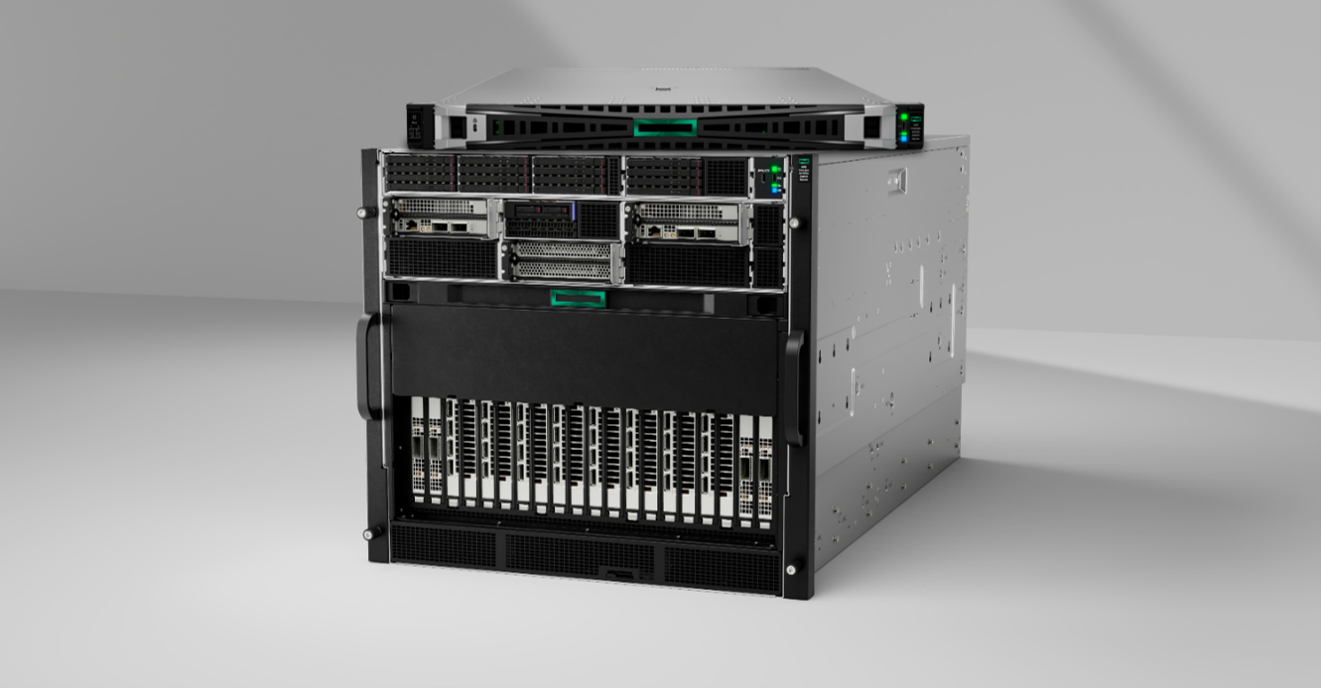
This is how I view new HPE ProLiant Gen13 Servers , including the HPE ProLiant DL525 Gen13 and HPE ProLiant DL585a Gen13 Servers. They are designed for different workload requirements, including agentic AI and inference, but I see a common objective: helping customers run demanding workloads efficiently securely, and with greater operational control.
For more detail on Gen13 be sure to check out my ProLiant Gen13 technical blog.
No single technology can solve an AI strategy on its own. But if the compute powering AI is inefficient, difficult to trust, or overly complex, everything built on top of it becomes harder.
AI is often described as the technology that will change everything. Perhaps its first contribution is to show us what still needs to change?